
Past work · Defense & aerospace
Zoic Labs
Transforming Defense Data Into Actionable, High-Velocity Tools
Personal note
Zoic is where I figured out I’m happiest when the UI has to survive a loud room—classified screen sharing, live data viz, a sentiment-driven BTC prototype for banking-side reviews, a USAF composer for feeds on an ops wall, a multi-timeline “time path” for disasters, early debris visualization. Different teams; same gut check when the firehose is on.
The place swung between lab energy and mission seriousness. That stuck with me more than any single deliverable.
01
Multi-domain workflows
Understanding multi-domain workflows
Discovery & program alignment
- Fragmented analyst tools — Intelligence teams were switching between unrelated systems to compare satellite data, diagnostics, and live feeds.
- Cross-product dependencies — All three tools shared overlapping needs in visualization, security, and multi-source data composition.
- Classification constraints — Each UI model required strict permission-based visibility to align with defense-level access control.
- Need for a unified framework — Early discovery showed the opportunity for shared components and interaction logic across all projects.
Project 1 · BTC investing simulation
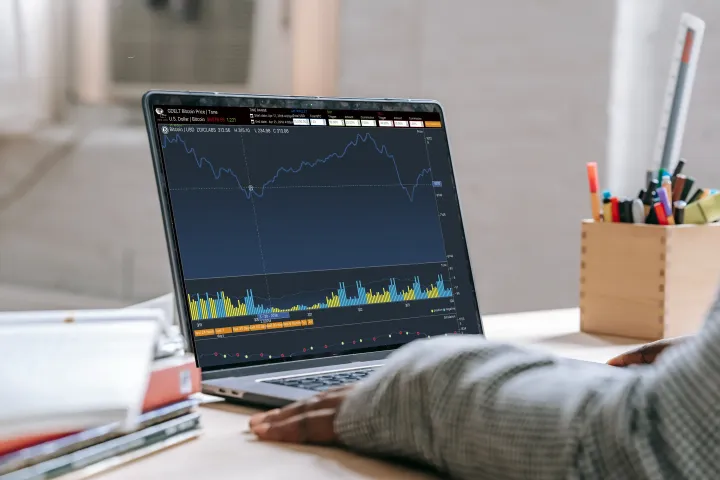
An internal experiment to simulate an exchange and purchasing flow for Bitcoin. Zoic explored a white-label BTC exchange for banking institutions—a timely concept in 2017-2019. The flows below show how sentiment from social sources could sit alongside price, history, and time controls.
Outcome — The simulation made the white-label story tangible for leadership: social sentiment, trade history, and time windows read as one coherent trading narrative banks could evaluate without committing engineering to a full exchange build.
02
System architecture
Defining the UX foundation across all three tools
- Screen-sharing architecture — Modeled how users switch between assets, manage layouts, and view feeds securely based on classification level.
- BTC simulation framework — Built structural patterns for sentiment overlays, time-series controls, and multi-panel analysis.
- Orbital debris mapping model — Established geospatial hierarchy, layer controls, and trajectory representations for space-object tracking.
- Modular interaction patterns — Created shared UI components to keep the three products consistent and scalable.
Project 2 · USAF classification screen sharing
A desktop application for the U.S. Air Force: a terminal-style experience where an operative composes multiple assets on a large shared display—live feeds, templates, diagnostics, and geospatial views—for rocket launches, space operations, and coordinated missions where many events happen at once. The UI had to support roughly 12–20 participants with real-time updates from multiple sources in one room.
Outcome — The composition model gave operators a single place to stage feeds and assets under classification rules, so a full room could stay aligned during fast-moving launches and missions instead of chasing windows across laptops.
03
Design & prototyping
Bringing complex visual systems to life
- Classification UI in action — High-fidelity interfaces showing live video, imagery, telemetry, and mapping tools inside a controlled-access viewer.
- BTC simulation visual design — Data-rich layouts for sentiment scoring, market deltas, comparative timelines, and prediction flows.
- Orbital debris visualization — Prototyped object paths, altitude bands, orbital decay, velocity states, and data-point inspection.
Project 3 · Multi-timeline disaster response
A natural-disaster response concept: a real-time interface for multiple timelines—or potential timelines—unfolding at once. Teams could insert plans, track how groups move through a scenario, and when a new obstacle appears, use inference and incoming data to branch into alternative timelines and recovery paths.
Outcome — The sequence pressure-tested how much parallel timeline data could live on one surface before coordination broke down—useful for arguing where inference, branching, and “what-if” lanes should appear in a real response tool.
04
Delivery & outcomes
A unified UX system supporting multi-year programs
- Complete spec packages — Delivered full workflows, interaction rules, and screen systems for all three tools.
- Visualization standards — Created reusable patterns for charts, geospatial controls, multi-feed layouts, and sentiment displays.
- Engineering-ready assets — Provided annotated design files, responsive layouts, and screen logic for development teams.
- Program expansion — Quality of the UX work contributed to extensions and new initiatives with defense and aerospace partners.